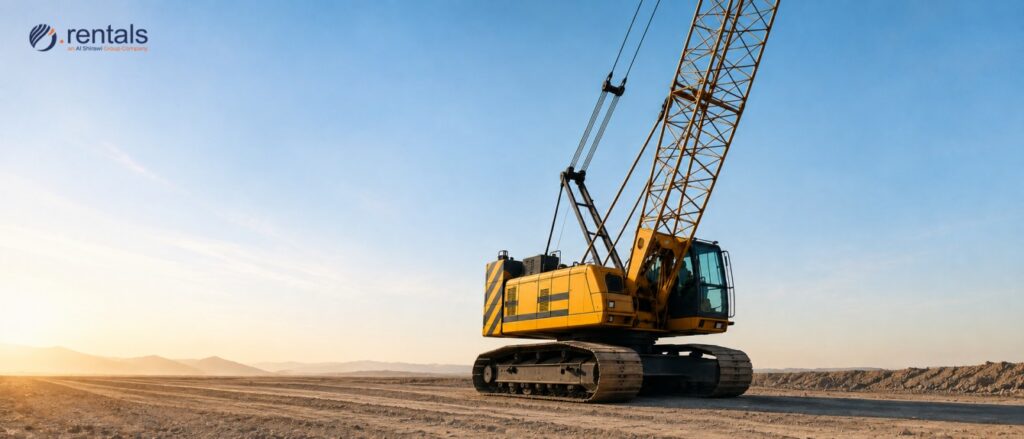
A crane sitting idle on site costs money every hour it isn’t lifting. On a compaction project with tight sequencing between soil treatment and follow-on works, that idle time doesn’t just delay one task — it ripples through the entire programme. This is why more contractors in the UAE are moving away from bare crane hire and toward operator-supported crane rental , where the crane arrives with a trained operator and a service team rather than just a set of keys.
The hidden cost of unsupported crane hire

Renting a crane without operator or maintenance support looks cheaper on paper. In practice, the cost often shows up later:
- Untrained or unfamiliar operators taking longer to reach safe, efficient lift cycles
- No one on hand to diagnose a mechanical issue, meaning the crane sits idle until a technician arrives
- Increased risk of operational errors on specialised work like dynamic compaction, where lift height, drop sequencing and timing all affect results
For dynamic compaction specifically, where a crane repeatedly lifts and drops a heavy tamper to compact soil, operator skill directly affects both safety and the quality of the ground improvement work. This isn’t a task suited to a general operator learning on the job.
What Operator-Supported Rental Actually Includes
With O.rentals, every crane rental for dynamic compaction work comes with more than the machine itself:
| Included | Why It Matters |
|---|---|
| Trained, experienced crane operators | Improve safety, increase lifting efficiency, and ensure consistent project performance |
| On-call maintenance and service support | Enables faster resolution of mechanical issues on site, minimizing downtime |
| Pre-mobilisation equipment checks | Reduce the risk of equipment breakdowns once work begins |
| Ongoing servicing during the rental period | Keeps the crane operating at peak performance throughout the project |
This model shifts the responsibility for uptime away from the contractor and onto the rental provider – which is exactly where it should sit, given how specialised compaction work can be.
Where downtime typically happens on compaction projects
Understanding where projects lose time helps explain why the operator-supported model matters so much:
- Mobilisation delays — an unfamiliar operator taking time to assess site conditions before starting work
- Mechanical faults with no immediate support — a crane going offline with no technician available to attend quickly
- Inconsistent lift cycles — less experienced operators working more cautiously, slowing throughput
- Miscommunication on drop sequencing — a critical factor in dynamic compaction, where poor sequencing can mean redoing sections of ground treatment
An operator-supported rental model addresses each of these directly, because the people running the crane and maintaining it are part of the same accountable team.
A practical example
Consider a contractor running a dynamic compaction programme across a multi-phase site. With bare hire, a mechanical fault mid-programme could mean a wait of a day or more for a third-party technician, pushing the entire schedule back. With an operator-supported crane rental, the service team attending the crane is already familiar with the machine and the site and is typically able to respond and resolve issues far faster, because uptime is built into the rental agreement, not an afterthought.
What to ask before renting a compaction crane

Before booking crane rental for dynamic compaction work, it’s worth confirming:
- Is an experienced operator included, or is this bare hire?
- What is the response time for mechanical issues during the rental period?
- Has the crane been serviced and inspected immediately prior to mobilisation?
- Does the rental company have specific experience supporting dynamic compaction, rather than general lifting work?
These questions separate providers who simply supply equipment from those who genuinely support project delivery.
Talk to O.rentals to Discuss Your Dynamic Compaction Needs
O.rentals supplies crane rental across Dubai with trained operators and an on-call service team as standard, specifically built around minimising downtime on demanding projects like dynamic compaction. If uptime and reliability are priorities for your next project, our team can talk through crane specification, operator support, and maintenance cover before you mobilise.
Contact O.rentals
Tel: +971 4 8855 169
Email: rentals@o.rentals
Services
Mobile: +971 50 107 6064
Toll Free: 800 RENT (7368)
Rental
Mobile: +971 50 640 9780
Toll Free: 800 LEASE (53272)
Address:
Dubai Investment Park 2, PO Box 282679, Dubai, UAE
Frequently Asked Questions (FAQs)
What is dynamic compaction and why does it need a crane?
Dynamic compaction is a ground improvement technique where a heavy weight is repeatedly lifted and dropped from height to compact loose or weak soil. A crane provides the controlled lift height and repeatable cycle needed for consistent results.
Does crane rental in Dubai usually include an operator?
Not always, many rentals are bare hire only. It's worth confirming this explicitly, as operator-supported rental significantly reduces the risk of downtime and inconsistent results.
How much downtime can operator-supported rental actually save?
It varies by project, but the biggest gains come from avoiding mechanical downtime with no immediate support, and from operators reaching efficient lift cycles faster than unfamiliar operators would.
What size crane is needed for dynamic compaction work?
This depends on the required drop height and tamper weight for your specific ground conditions. A rental provider experienced in compaction work can help specify the right crane for your project.
Is operator-supported crane rental more expensive than bare hire?
The day rate is typically higher, but total project cost is often lower once downtime, inefficient cycles, and risk of error are factored in.
How quickly can O.rentals mobilise a crane for a compaction project?
Mobilisation timelines depend on crane availability and site requirements — contact our team directly for a project-specific timeline.