It’s 9am on a Tuesday and a warehouse supervisor in Jebel Ali is staring at a forklift that won’t start. The delivery trucks are already queuing at the dock. A technician is on his way, but he won’t arrive for two hours, and the quote for the hydraulic pump repair is still unknown. This is the moment every fleet owner dreads. Not the breakdown itself, but the uncertainty that comes with it.
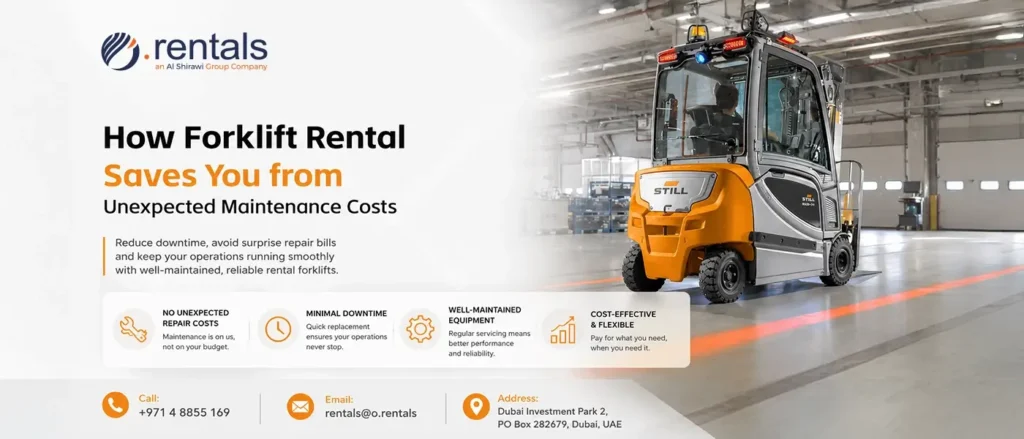
Unplanned maintenance is one of the biggest hidden costs of owning a forklift. It doesn’t show up in the purchase price, and it rarely fits neatly into a budget. Forklift rental services exist precisely to remove that uncertainty, shifting the responsibility for upkeep, repairs and breakdowns onto the rental provider instead of the business trying to keep its operations running.
This article looks at why maintenance costs catch forklift owners off guard, how forklift rental services in Dubai and across the UAE solve that problem, and what to check before signing a rental or leasing agreement.
Why Forklift Maintenance Costs Are So Unpredictable
Forklifts are workhorses. They lift, reverse, brake and idle for hours at a time, often in dusty yards or humid warehouses that accelerate wear on hydraulics, tyres and electrical components. Because usage varies so much from one operation to another, maintenance needs rarely follow a predictable schedule.
A few factors make costs especially hard to forecast for owned equipment:
- Usage intensity. A forklift running three shifts a day wears out components far faster than a machine used occasionally, but most maintenance plans assume average use.
- Operating environment. Dust, heat, saltwater air near ports, and cold storage conditions all shorten component life in different ways.
- Operator variation. Rough handling, overloading and inconsistent operators increase strain on transmissions and mast assemblies.
- Ageing fleets. Machines older than five to seven years typically need more frequent, and more expensive, repairs — often just as their resale value is dropping.
- Parts and labour availability. Sourcing OEM parts for specific brands can take days, during which the machine sits idle and the business absorbs the lost productivity.
None of these factors are things a warehouse manager can fully control. That’s exactly why the maintenance line item on an owned fleet’s budget is so often wrong.

Want predictable equipment costs without unexpected repair bills? Explore forklift rental Dubai for flexible short- and long-term material handling requirements.
The Real Cost of an Unexpected Breakdown
A repair invoice is only part of the story. When a forklift goes down unexpectedly, the business also absorbs:
Cost Type | Example Impact |
Repair parts and labour | AED 2,000–15,000+ depending on the fault |
Lost productivity | Delayed loading/unloading, missed delivery windows |
Rental of a temporary replacement | Additional short-notice cost, often at a premium |
Overtime to catch up on backlog | Extra labour cost after downtime |
Reputational impact | Late shipments to clients or 3PL partners |
Add these together and a single mechanical failure can cost a business far more than the repair bill alone. It’s this compounding effect, repair cost plus lost productivity plus scrambling for a solution, that makes unplanned maintenance one of the most disruptive expenses in warehousing and logistics.

Businesses looking to reduce maintenance risk can rent a forklift in Dubai with servicing and technical support included according to the rental agreement.
How Forklift Rental Removes the Maintenance Risk
This is where forklift rental services change the equation. Instead of the business owning the risk of every mechanical fault, that risk sits with the rental provider.
Maintenance Is Built Into the Agreement
With a forklift rental or forklift lease, servicing, parts, and routine maintenance are typically included in the contract. The equipment provider is responsible for keeping the machine in good working order, not the warehouse team. If something fails, it’s the provider’s job to fix it, often with a replacement unit provided in the meantime so operations don’t stop.
You're Working With Well-Maintained, Modern Equipment
Reputable rental companies maintain their fleets on a preventive schedule, not a reactive one. That means forklifts are serviced before problems occur, not after a breakdown forces the issue. Renting also gives businesses access to the latest equipment, rather than relying on an ageing machine that’s past its most reliable years.
Lower Upfront Costs, More Predictable Running Costs
Buying a forklift ties up capital that could otherwise fund inventory, staffing or expansion. A forklift rental or lease avoids that large upfront cost and replaces it with a predictable monthly or contract-based fee; one that already accounts for servicing, rather than leaving repairs as an unbudgeted surprise.
Flexibility Without the Long-Term Liability
Seasonal spikes, short-term contracts and project-based warehousing don’t always justify owning equipment outright. Renting lets a business scale its fleet up or down as demand changes, without carrying the ongoing maintenance liability of machines that might sit idle for part of the year.
Ownership vs Rental: Where the Maintenance Burden Sits
| Owning a Forklift | Renting a Forklift |
Who arranges servicing | The business | The rental provider |
Who pays for unexpected repairs | The business | Usually covered under the agreement |
Equipment age | Can age past its most reliable years | Access to newer, well-maintained fleet |
Budget predictability | Variable, hard to forecast | Fixed rental cost, few surprises |
Downtime response | Depends on in-house resources | Provider typically arranges replacement |
Upfront investment | High | Low |
This isn’t to say ownership is always the wrong choice, for some high-utilisation, long-term operations, owning equipment can still make sense. But for most warehouses, logistics operators and construction sites in the UAE, the maintenance burden alone is a strong argument for renting or leasing rather than buying.

What to Check Before Choosing a Forklift Rental Provider
Not all rental agreements are equal. Before signing, it’s worth confirming:
- What maintenance is included — routine servicing only, or full parts and labour coverage too?
- Response times for breakdowns — is there a guaranteed turnaround, and is a replacement machine provided?
- Fleet age and condition — ask how old the average unit is and how often it’s serviced.
- Operator training and compliance support — does the provider offer certified training, reducing the risk of misuse-related faults?
- Contract flexibility — can terms scale from a single day to several years depending on project needs?
A provider that can answer these clearly, rather than vaguely, is usually one that has genuinely built maintenance into its operating model.
How O.rentals Handles This
O.rentals is the rental and leasing division of Al Shirawi, operating in the UAE since 2006 from a 32,520-square-metre facility in Dubai Investment Park. The fleet includes electric, diesel and LPG forklifts, along with warehouse equipment such as reach trucks, order pickers and pallet stackers, sourced from global manufacturers including; STILL, HD Hyundai Material Handling and Manitou.
Maintenance is handled by a dedicated team of around 150 support professionals, backed by preventive servicing schedules and a remote fleet monitoring system that flags issues before they become breakdowns. Rental terms run from a single day up to seven years, giving businesses the flexibility to match equipment to the length of the job rather than committing to ownership. Certified operator training is also available, reducing the kind of misuse-related wear that often leads to costly repairs.
For a warehouse, logistics operation or construction site in Dubai weighing up whether to buy or rent, this is the practical difference: with forklift rental, the maintenance risk — and the unpredictable cost that comes with it — sits with the provider, not the business.

Get a Reliable Forklift Rental Without the Maintenance Guesswork
Unplanned repair bills are one of the easiest costs to underestimate, and one of the easiest to avoid. O.rentals provides forklift rental and forklift leasing solutions across Dubai and the UAE, backed by a well-maintained fleet, expert technical support and flexible contract terms from one day to seven years.
Get in touch with O.rentals:
Tel: +971 4 8855 169
Email: rentals@o.rentals
Services
Mobile: +971 50 107 6064
Toll Free: 800 RENT (7368)
Rental
Mobile: +971 50 640 9780
Toll Free: 800 LEASE (53272)
Address:
Dubai Investment Park 2, PO Box 282679, Dubai, UAE
Frequently Asked Questions (FAQs)
Does forklift rental include maintenance?
In most agreements with O.rentals, yes. Routine servicing and repairs are handled by the provider as part of the rental or lease, rather than being billed separately when something breaks.
Is renting a forklift cheaper than buying one long-term?
It depends on usage. For continuous, years-long, single-site operations, ownership can sometimes work out cheaper. For most businesses with variable demand, renting avoids the large upfront cost and unpredictable repair bills that come with ownership.
What happens if a rented forklift breaks down?
A reputable forklift rental provider will typically arrange rapid repairs or a temporary replacement, so operations aren't left waiting on an unbudgeted repair. O.rentals can also provide where required on site team and operators to assist your operations.
Can I rent a forklift for a short-term project only?
Yes. Forklift rental services are commonly available from a single day up to multi-year leases, making them suitable for both short-term projects and ongoing operations.
What types of forklifts are available for rent in Dubai?
Electric, diesel and LPG forklifts are all commonly available, alongside warehouse equipment like reach trucks, order pickers and pallet stackers, depending on the application.
Does forklift leasing include operator training?
Some providers, including O.rentals, offer certified operator training alongside rental agreements, which helps reduce misuse-related maintenance issues.
Is older or newer equipment better for avoiding breakdowns?
Newer, well-maintained equipment generally has fewer unexpected faults. One advantage of renting is ongoing access to updated equipment rather than relying on an ageing, owned machine.