When a piling project falls behind schedule, the cause may be more than the number of piles to install. Unsuitable equipment, difficult ground conditions, poor access or an incorrectly specified hammer can all affect productivity.
For contractors working across the UAE, choosing the right vibro hammer is an important part of planning an efficient piling operation. The equipment must suit the pile, the soil conditions, the available lifting machinery and the requirements of the site.
A vibro hammer for piling uses rapid vibration to help drive piles into the ground or extract them when temporary structures are removed. Different models are designed for different applications, from crane-supported sheet-pile installation to excavator-mounted operations and specialist side-grip systems.
Understanding these options helps contractors identify suitable piling vibro equipment before committing to a rental or purchase.
What Is a Vibro Hammer and How Does It Work?
A vibro hammer is a mechanical piling attachment that uses vibration to help overcome resistance between a pile and the surrounding soil. Depending on the model and application, it can be used to install suitable piles or extract existing ones.
Hydraulic vibro hammers commonly use rotating eccentric weights to generate vibration. The hammer grips the pile through a clamp and transfers vibration into it. A crane or excavator supports and positions the equipment while the pile advances under the combined effects of vibration, applied force and the equipment’s weight.
The installation process generally involves five stages:
- Positioning: The operator places the pile at the required location.
- Clamping: The vibro hammer securely grips the pile using a compatible clamp.
- Starting the equipment: The operator activates the hammer according to the manufacturer’s procedures.
- Pile installation: Vibration helps the pile penetrate the ground under suitable conditions.
- Checking progress: The team monitors alignment, penetration and compliance with the project requirements.
The same general principle can be used for pile extraction, where vibration helps reduce resistance as the pile is lifted from the ground.
Not every vibro hammer is suitable for every pile or soil condition. Correct equipment selection depends on the required application, pile dimensions, ground profile and machine specifications.
Which Types of Vibro Hammer Are Available?
Vibro hammers come in several configurations. The right choice depends on how the equipment will be supported, the type of pile being handled and the working conditions on site.
OMS offers several vibro hammer configurations for piling applications, including crane-mounted, excavator-mounted, variable-moment and side-grip models. These options allow contractors to consider different installation requirements when planning their equipment selection.
1. Crane-Mounted Vibro Hammers
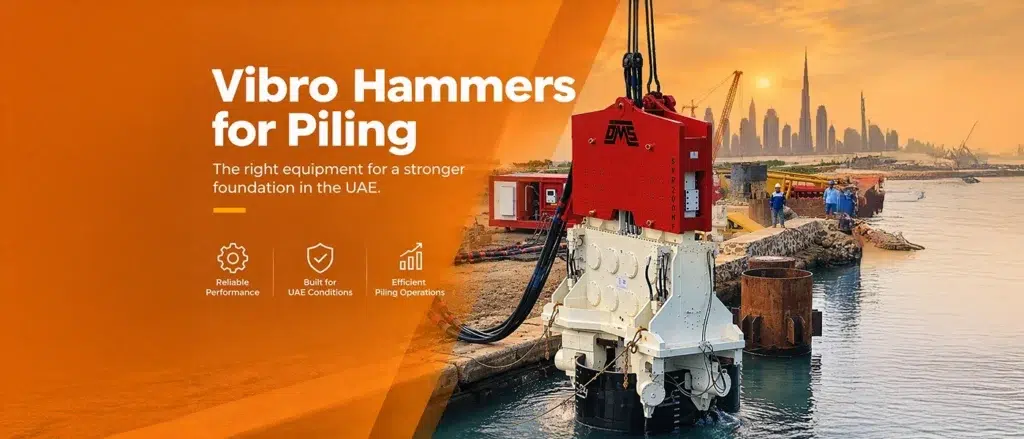
Crane-mounted vibro hammers are suspended from a suitable crane and used to position, install or extract piles.
The crane provides lifting capacity, reach and control over the equipment’s position. This configuration can be useful when working with long piles, sheet-pile walls or projects where the installation area requires lifting equipment to operate from a designated position.
Common applications include:
- Installing sheet piles for excavation support.
- Installing suitable steel piles for foundations.
- Supporting marine and waterfront construction.
- Extracting temporary piles during the removal of temporary works.
When selecting a crane-mounted vibro hammer, check the combined lifting requirements, including the hammer’s weight, pile weight, clamp and any relevant rigging. Crane capacity must be assessed against the applicable load chart, working radius and lifting configuration.

2. Excavator-Mounted Vibro Hammers
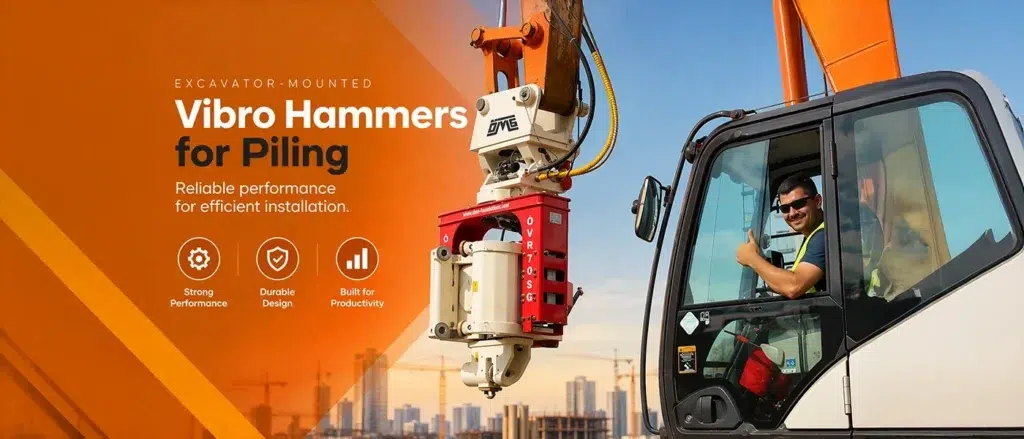
Excavator-mounted vibro hammers attach to a compatible excavator, allowing the carrier machine to position and operate the equipment.
This arrangement may be useful where an excavator offers practical access, mobility or positioning advantages. It can suit certain piling operations in construction areas where the equipment must move between installation points.
Before selecting an excavator-mounted vibro hammer, confirm compatibility between the attachment and the carrier machine.
Important checks include:
- Excavator weight and stability.
- Hydraulic flow and operating pressure requirements.
- Attachment weight and mounting compatibility.
- Required reach and working geometry.
- Pile dimensions and the intended installation method.
An excavator’s size alone does not establish compatibility. The attachment manufacturer’s requirements and the machine’s technical specifications must be checked together.

3. Variable-Moment Vibro Hammers
Variable-moment vibro hammers allow the operating eccentric moment to be adjusted according to the equipment design.
This capability can help the operator manage vibration characteristics during different stages of an installation. Depending on the model, variable-moment technology may also help control the vibration generated during start-up and shutdown.
These characteristics can be particularly relevant where contractors need to consider vibration effects on nearby buildings, utilities or other sensitive structures.
Variable-moment equipment is not automatically suitable for every sensitive site. The actual vibration response depends on the hammer, pile, ground conditions, operating settings and surrounding environment. A project-specific assessment may still be required.
When comparing models, ask the supplier about the available adjustment range, operating requirements and the conditions under which the equipment is designed to operate.

4. Side-Grip Vibro Hammers
Side-grip vibro hammers grip the pile from the side rather than relying solely on a conventional top-mounted gripping arrangement.
This configuration can be useful for handling certain piles where side access or the pile-handling arrangement influences equipment selection.
Depending on the equipment design, side-grip systems may help with positioning, installation and extraction operations involving suitable piles.
Before specifying a side-grip vibro hammer, confirm:
- The pile profile and dimensions.
- The permitted gripping range.
- The pile’s weight and handling requirements.
- Access for the carrier or lifting machine.
- The manufacturer’s operating limitations.
The gripping arrangement must be compatible with the pile and the intended operation. A side-grip model should not be selected based on access alone.
How Do You Choose the Right Vibro Hammer for Your Piling Project?
The best vibro hammer is not necessarily the largest or most powerful model. It is the equipment that meets the project’s installation requirements while remaining compatible with the pile, carrier machine and site conditions.
Use the following factors to guide the selection process.
1. Start with the pile specifications
Pile dimensions have a direct bearing on the equipment required.
Consider:
- Pile material and profile.
- Length and weight.
- Required installation depth.
- The number of piles to install.
- Whether the work involves installation, extraction or both.
For sheet-pile projects, the profile and length of the sheets influence the clamp arrangement and equipment requirements. Other steel piles may require different gripping and handling solutions.
Providing accurate pile information at the quotation stage helps a supplier assess which models may be suitable.
2. Assess the ground conditions
Soil conditions affect how a pile responds to vibration and how readily it penetrates the ground.
Vibro hammers are often effective in suitable granular soils, but performance can vary considerably depending on soil density, layering, groundwater and obstructions.
Dense ground, stiff cohesive soils, cobbles or unexpected obstructions may increase resistance and make installation more difficult. A vibro hammer should not be assumed to achieve the required depth in every soil condition.
Review the geotechnical investigation and discuss any uncertainty with the project’s geotechnical engineer or piling specialist before finalising the equipment specification.
3. Check the carrier machine
A vibro hammer must work within the limits of its supporting crane or excavator.
For a crane-mounted system, confirm lifting capacity, operating radius, hammer weight, pile weight and the complete lifting arrangement.
For an excavator-mounted system, check the attachment interface, hydraulic flow, operating pressure, machine stability and manufacturer’s compatibility requirements.
An equipment mismatch can affect performance, create operational risks and lead to avoidable delays.
4. Consider vibration, noise and nearby structures
Vibro hammers can generate significant ground-borne vibration and noise. The level of impact on the surrounding area depends on the equipment settings, pile, soil, distance and site conditions.
Where piling takes place near occupied buildings, utilities, existing foundations or other sensitive assets, the project team should determine whether monitoring or additional controls are needed.
Variable-moment equipment may offer useful operating flexibility, but it does not eliminate vibration risk. The appropriate method and operating limits should be determined through project-specific assessment.
5. Match equipment capacity to the programme
Installation speed depends on several variables, including pile dimensions, ground resistance, equipment capability, positioning time and the operator’s experience.
For a large piling programme, the right equipment can help reduce avoidable downtime and maintain a consistent workflow. For smaller projects, access and ease of mobilisation may be equally important.
Discuss the expected number of piles, installation depth, working hours and programme with the equipment supplier. This provides a more useful basis for selection than comparing machine specifications in isolation.
What Affects Vibro Hammer Performance?
Even correctly selected equipment can perform differently from one site to another. Understanding the main variables helps contractors plan realistic programmes and identify potential problems early.
Factor | How it affects performance | What to check |
Soil resistance | Higher resistance can reduce penetration speed or prevent the pile reaching its target depth | Geotechnical report, soil layers and possible obstructions |
Pile dimensions | Pile profile, length and weight affect handling and equipment requirements | Pile drawings and installation specification |
Hammer capacity | The equipment must provide suitable performance for the intended pile and ground conditions | Manufacturer specifications and supplier assessment |
Carrier compatibility | Insufficient lifting or hydraulic capacity can prevent correct operation | Crane load chart or excavator specifications |
Site access | Restricted access can limit machine positioning and pile handling | Working area, overhead restrictions and delivery access |
Operator experience | Incorrect setup or operation can affect productivity and safety | Operator competency and approved method statement |
Neighbouring structures | Vibration and noise restrictions may influence the method and operating settings | Site constraints, monitoring requirements and project controls |
If the pile stops advancing, begins to deviate from its intended alignment or behaves unexpectedly, the team should investigate the cause rather than simply increasing operating effort. Ground conditions, equipment suitability, pile alignment and obstructions may all need to be reviewed.
Vibro Hammer Rental or Purchase: Which Makes Sense?
For contractors planning a piling project in the UAE, renting and purchasing both have advantages. The appropriate option depends on the expected frequency of use, project duration, equipment requirements and the contractor’s existing fleet.
When renting may be the better option
Vibro hammer rental may suit contractors who need equipment for a defined project or want access to a suitable model without committing to ownership.
Rental can be worth considering when:
- The project has a clear start and finish date.
- The equipment is required only occasionally.
- Different projects require different hammer configurations.
- The contractor wants to limit the capital tied up in specialist equipment.
- The project requires a model not already available in the company’s fleet.
Before confirming a rental, check availability, delivery arrangements, included accessories, technical support, mobilisation costs and the responsibilities for maintenance and operation.
When purchasing may be appropriate
Buying a vibro hammer may make sense for contractors with regular piling work and predictable long-term demand.
Ownership can provide greater control over equipment availability and scheduling. It also requires the buyer to account for maintenance, storage, servicing, transport and the cost of keeping specialist machinery ready for use.
A purchase decision should consider the expected utilisation over the equipment’s working life, rather than the initial purchase price alone.
What should you include in a quotation request?
To help the supplier recommend a suitable vibro hammer, provide as much of the following information as possible:
- Project location in the UAE.
- Type, dimensions and length of the piles.
- Estimated number of piles and installation depth.
- Available crane or excavator model.
- Soil conditions and relevant geotechnical information.
- Whether the requirement is for installation, extraction or both.
- Expected project duration and required delivery date.
- Any site restrictions relating to access, vibration or noise.
These details help the supplier assess the application and identify the information still needed before confirming equipment suitability.
Common Mistakes to Avoid When Selecting Piling Vibro Equipment
Several avoidable mistakes can lead to delays, unexpected costs or equipment that is unsuitable for the work.
Choosing by size alone: A larger hammer is not automatically the right choice. Compatibility with the pile, soil and carrier machine matters more than size in isolation.
Ignoring hydraulic requirements: An excavator-mounted attachment must operate within the carrier’s specified hydraulic flow and pressure limits.
Assuming every soil type is suitable: Ground conditions can substantially affect penetration. Review the geotechnical information before selecting the installation method.
Overlooking site constraints: Nearby buildings, utilities, access restrictions and vibration limits can influence the equipment and working method.
Providing incomplete information when requesting a quote: Without pile dimensions, carrier details and project requirements, it may be difficult for the supplier to assess the most appropriate model.
Leaving equipment planning too late: Confirming technical requirements, availability, delivery and mobilisation arrangements early can help reduce programme risk.
Find the Right Vibro Hammer for Your UAE Project
Selecting suitable piling equipment starts with understanding the work to be completed. Pile dimensions, soil conditions, machine compatibility, access and site constraints all influence which vibro hammer is appropriate.
O.rentals offers OMS vibro hammer configurations including crane-mounted, excavator-mounted, variable-moment and side-grip models, alongside supporting equipment such as hydraulic power packs and hydraulic clamps. The appropriate combination depends on the application and the specifications of the equipment available.
If you are planning a piling project in the UAE, explore the OMS product range and contact the team to discuss your requirements. The team can also advise on operator training where it’s needed alongside the equipment.
Get in Touch
Tel: +971 4 8855 169
Email: rentals@o.rentals
Services
Mobile: +971 50 107 6064
Toll Free: 800 RENT (7368)
Rental
Mobile: +971 50 640 9780
Toll Free: 800 LEASE (53272)
Address
Dubai Investment Park 2, PO Box 282679, Dubai, UAE
Frequently Asked Questions (FAQs)
What is a vibro hammer used for?
A vibro hammer is used to install suitable piles into the ground or extract them. Common applications include sheet-pile installation, temporary retaining structures and certain steel-pile operations. Suitability depends on the equipment, pile type and ground conditions.
What is the difference between a crane-mounted and an excavator-mounted vibro hammer?
A crane-mounted vibro hammer is suspended from a compatible crane, while an excavator-mounted model attaches to a suitable excavator. The best option depends on lifting or hydraulic capacity, access, pile-handling requirements and the manufacturer's specifications.
What is a variable-moment vibro hammer?
A variable-moment vibro hammer allows the operating eccentric moment to be adjusted within the equipment's designed range. This can provide greater control over vibration characteristics during operation. Actual performance and suitability depend on the specific model and site conditions.
Can a vibro hammer install sheet piles?
Yes. Vibro hammers are commonly used to install suitable sheet piles for applications such as excavation support and retaining walls. The hammer, clamp and carrier must be compatible with the sheet-pile profile, length, ground conditions and project requirements.
Can vibro hammers extract piles?
Yes. Suitable vibro hammers can be used to extract piles, including temporary sheet piles, by applying vibration to help overcome resistance from the surrounding ground. The extraction method must be appropriate for the pile, soil and site conditions.
Are vibro hammers suitable for every soil type?
No. Performance varies with soil density, cohesion, layering, groundwater and obstructions. A geotechnical assessment and review of the pile design are important when determining whether vibratory installation is suitable.
Should I rent or buy a vibro hammer?
Renting may suit short-term projects or occasional use, while purchasing may be appropriate for contractors with regular, long-term demand. Compare project duration, expected utilisation, maintenance, transport, availability and total cost before deciding.
What information is needed to select a vibro hammer?
Useful information includes pile dimensions and weight, required installation depth, soil conditions, carrier-machine details, project duration and any site restrictions. A specialist supplier can use these details to assess potential equipment options.