A well-maintained forklift is only one part of a safe site. The rest is everything around it: the documents you verify, the checks made at the start of every shift, the operator at the controls, and the ground the truck runs on.
O.rentals has supplied forklifts and warehouse equipment across the UAE since 2006, and the pattern is consistent. The sites with the strongest safety records treat every equipment handover as a checkpoint, whoever the supplier is and whatever the machine. Their routines are simple, repeatable and written down.
This guide sets out those checks in the order we recommend them. Whether you’re arranging forklift rental in the UAE for the first time or reviewing how your team manages equipment it already hires, it will help you know what to ask for, what to inspect and what good looks like.
The short answer: what should you check on a rented forklift?
Before any hired forklift goes into use, confirm five things:
- Valid documentation, including a current inspection certificate and service record
- A physical walk-around of brakes, steering, forks, mast, tyres, lights and safety devices
- Operator competence on that specific truck type
- Site readiness, covering traffic routes, floor condition and charging or fuel storage
- Support arrangements for servicing, breakdowns and spare parts
For a shorter form that supervisors and operators can use alongside this guide, see the forklift and material-handling safety checklist.
The sections below explain each one.

Start with the paperwork, not the machine
It is tempting to walk straight to the truck. Start with the documents instead. They tell you how the machine has been looked after, and a supplier who struggles to produce them is already giving you information.
Ask to see:
- A current thorough examination or third-party inspection certificate. Many UAE sites, main contractors and client HSE teams will not allow lifting equipment through the gate without one. Check the date and the serial number and confirm it matches the truck in front of you.
- The service history. You want evidence of regular preventive maintenance, not a single entry from 18 months ago.
- The rated capacity plate and load chart. The plate must be legible and fitted. If you use attachments, the capacity changes, and the plate should reflect it.
- The operator manual, ideally kept in the cab or on the truck.
- A handover or delivery checklist signed by both parties, recording the condition of the machine on arrival.
Requirements differ between emirates and between sites. Abu Dhabi projects often work under OSHAD requirements, Dubai sites may follow Dubai Municipality expectations, and free zones and major clients add their own rules. Ask your HSE lead or main contractor what applies before the truck arrives, not after.
The physical walk-around: what to look at
A competent operator should do this at the start of every shift. As site manager, do it yourself at handover so you know what ‘good’ looks like.
Component | What to check | Red flag |
Forks | Straight, no cracks, heel not worn thin, locking pins secure | Visible bends, cracks near the heel, uneven tip height |
Mast and chains | Smooth lift and tilt, chains evenly tensioned and lubricated | Jerky movement, chain stretch, rust, noise |
Hydraulics | Hoses and cylinders dry and undamaged | Wet patches, weeping seals, bulging hoses |
Brakes | Service brake firm, parking brake holds on a slope | Soft pedal, long stopping distance, handbrake creep |
Steering | Smooth, no excess play | Stiffness, wandering, clunking |
Tyres | Even wear, no deep cuts or chunking, correct pressure for pneumatic types | Cracks, missing chunks, flat spots |
Lights, horn, beacon | All working, including reverse alarm | Any dead light, weak horn, silent reverse alarm |
Seat belt and restraint | Fitted, retracts, buckles securely | Frayed webbing, missing or tied-back belt |
Overhead guard and load backrest | Intact and undamaged | Weld cracks, impact damage, missing parts |
Fluid levels | Engine oil, coolant, hydraulic oil, brake fluid | Low levels or a milky or burnt appearance |
Test the truck as well as looking at it. Drive it a few metres, brake, lift an unloaded fork to full height and tilt it. Listen for anything unusual.
Expert tip: photograph the truck from all four sides, plus the data plate and hour meter, before it goes into use. If a dispute over damage arises at the end of the hire, those photos settle it in minutes.
Need a Forklift Matched to Your Site?
Compare the available rental fleet by equipment type, brand, and load capacity before requesting a quotation.

Forklift Rental UAE: Site Manager Safety Checks
Operator competence is the check most sites skip
A perfect machine is still dangerous with the wrong person on it. A diesel counterbalance truck, an electric reach truck and a very narrow aisle truck handle very differently, and a licence for one does not mean competence on another.
Before a rented forklift is used, confirm that:
- Every operator holds a valid licence or certificate appropriate to your site’s requirements
- They have been familiarised with this specific truck, including its controls, load chart and any attachments
- They know your site rules, such as speed limits, pedestrian zones, one-way systems and reversing procedures
- Authorised operators are named. ‘Whoever is free’ is not an authorisation system.
If your team is new to a truck type, ask the rental company whether operator training or familiarisation is available. O.rentals offers certified operator training programmes, which is useful when you are introducing equipment your crew hasn’t used before.
UAE conditions change how forklifts fail
A forklift that behaves perfectly in a cool, dry climate can struggle in July. Site managers here should pay attention to a few local factors.
Heat
Engines and hydraulic systems run hotter. Check coolant levels and radiator condition more often in summer, and watch for overheating warnings. On electric trucks, heat affects battery performance and charging, so make sure the charging area has ventilation and that batteries aren’t left in direct sun.
Dust and sand
Air filters clog faster, and fine dust gets into hydraulics and electrical connectors. Ask how often filters are inspected and make sure the cab and operator controls are kept clean.
Tyres on hot surfaces
Pneumatic tyre pressure rises with temperature. Hot tarmac and concrete accelerate wear, so check pressures in the morning rather than mid-afternoon.
Operator fatigue
Heat affects people as well as machines. Rotate operators, make sure shaded rest and water are available, and remember that work-hour restrictions during the summer midday break may change your shift patterns and equipment utilisation.
Fuel and gas storage
If you hire LPG forklifts, cylinders must be stored upright, secured, away from heat sources and in a designated, ventilated area. Diesel needs proper spill-controlled storage.
Your site is part of the safety equation
Many forklift incidents are caused by the environment rather than the truck. Before the machine arrives, walk the route it will use and check:
- Floor load capacity and surface condition. Potholes, drain covers, expansion joints and ramps matter more than people expect.
- Gradients. Check them against the truck’s rated gradeability, especially when carrying a load.
- Pedestrian separation. Marked walkways, barriers and crossing points should be in place, not planned.
- Visibility. Check blind corners, lighting levels for night shifts and mirror placement.
- Racking. Check aisle widths against the truck’s turning requirements and confirm that rack uprights are protected and undamaged.
- Charging and refuelling areas. These should be away from traffic and fitted with the right extinguishers and signage.
A short risk assessment for each new truck type is worth the half hour. It also gives you something to point to when auditors or clients ask.
Daily and weekly checks during the hire
Handover is only the first check. Build a routine for the rest of the rental period.
Every shift (operator)
- Walk-around inspection before use, recorded on a checklist
- Report any defect immediately, and remove the truck from service if it affects brakes, steering, lifting or visibility
- Never operate a truck with a known safety fault ‘just until the end of the shift’
Weekly (supervisor)
- Review completed checklists for patterns, such as the same tyre or hose flagged repeatedly
- Check fluid top-up records
- Confirm the inspection certificate remains in date
Per service interval (rental company):
- Planned preventive maintenance carried out and documented
- Hour-meter readings logged against the service schedule

Why after-sales support is a safety question
A breakdown is inconvenient. A breakdown with no quick fix tempts people into shortcuts, such as borrowing a different truck without training, running a machine with a ‘minor’ fault, or stacking pallets by hand to keep the schedule.
That is why support arrangements belong on your safety checklist, not just your commercial one.
- After-sales service determines how fast a fault gets fixed. Ask for realistic response times and whether technicians can reach your site, including out of hours. O.rentals provides 24×7 service on request, backed by a team of around 150 technical and support staff.
- Genuine spare parts matter because brakes, chains, hoses and safety switches are not places for improvisation. Genuine components are made to the manufacturer’s specification and keep the truck within its design limits.
- Maintenance contracts take the guesswork out of servicing. Planned inspections catch worn components before they fail, and the paperwork supports your compliance records. For long-term hires or leasing arrangements, a defined maintenance schedule is far safer than ‘call us when it breaks’.
When comparing forklift rental services, ask who services the truck, how often, using which parts, and what happens when it goes down at 2am.
Questions to ask before you sign
Put these to any provider of forklift leasing or short-term hire:
- When was this specific truck last inspected, and by whom?
- Can I see the service record and the current certificate?
- Which maintenance schedule applies during my hire, and who performs it?
- What is your response time for breakdowns, and is out-of-hours cover included?
- Do you supply genuine spare parts?
- Can you provide operator training or familiarisation?
- Does the truck have remote monitoring or hour tracking to confirm service intervals?
Clear, specific answers are a good sign. Vague ones tell you where the risk sits.
Make safety part of the hire, not an afterthought
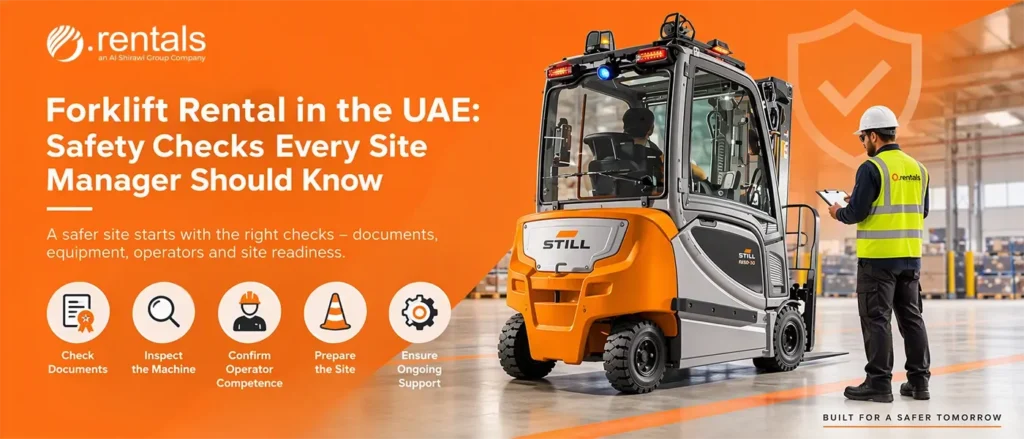
Safe forklift operation in the UAE comes down to a repeatable routine: check the documents, inspect the machine, confirm the operator, prepare the site, and make sure support is there when you need it.
If you’d like a second opinion on your setup, or you’re comparing forklift rental services for an upcoming project, the O.rentals team can help. Based in Dubai Investment Park, O.rentals is the rental and leasing division of Al Shirawi Enterprises and has supplied forklifts and warehouse equipment across the UAE since 2006, with after-sales service, genuine spare parts and maintenance contracts available.
Get in touch with O.rentals:
Tel: +971 4 8855 169
Email: rentals@o.rentals
Services
Mobile: +971 50 107 6064
Toll Free: 800 RENT (7368)
Rental
Mobile: +971 50 640 9780
Toll Free: 800 LEASE (53272)
Address:
Dubai Investment Park 2, PO Box 282679, Dubai, UAE
Frequently Asked Questions (FAQs)
Who is responsible for forklift safety on a rented truck?
Responsibility is shared. The rental company must supply a safe, maintained machine with valid documentation. Once it is on your site, you are responsible for competent operators, safe working areas, daily checks and reporting defects.
Do I need a licence to operate a forklift in the UAE?
Operators should be trained and certified for the type of truck they use. The exact requirements depend on your emirate, site and client, so confirm them with your HSE team before operators start.
How often should a forklift be inspected?
Operators should carry out a pre-use check every shift. A formal thorough examination by a competent person is typically required periodically, and many UAE sites require the certificate to be current throughout the hire. Servicing intervals depend on the manufacturer and operating hours.
What should I do if a rented forklift develops a fault?
Stop using it, tag it out and contact the rental company straight away. Don't attempt repairs unless you are authorised to, and don't continue ‘carefully’ with a brake, steering or hydraulic fault.
Is it safer to rent or buy a forklift?
Neither is automatically safer. Renting from a reputable supplier usually means a recently maintained, certified machine and support included, while owning puts maintenance and compliance entirely on you.
Does summer heat affect forklift safety?
Yes. Heat can cause overheating, accelerate tyre wear and reduce battery performance on electric trucks, and it raises operator fatigue risk. More frequent fluid, tyre and cooling checks help.
What documents should come with a rented forklift?
An inspection certificate, service history, capacity plate, operator manual and a signed handover checklist.