Warehouse managers across the UAE face the same recurring question when planning storage upgrades or seasonal operations: should you rent a reach truck or stick with a standard counterbalance forklift? The answer affects racking design, storage density, aisle width, operator training and, ultimately, how much product you can move through your facility each day.
This guide is written for warehouse managers, logistics coordinators, procurement teams and facility operators in the UAE who are deciding on the right equipment for narrow-aisle storage, high-bay racking or general material handling. Whether you’re setting up a new distribution centre or scaling operations during a busy season, choosing between a reach truck and a standard forklift has a direct impact on space utilisation, safety and running costs.
Reach truck rental has become a preferred option for many UAE businesses because it allows warehouses to access specialised, narrow-aisle equipment without the capital outlay of buying it outright. This article breaks down exactly when a reach truck outperforms a standard forklift, what the practical differences are, and how to decide which one suits your warehouse. We’ll also look at reach truck hire options, typical use cases and the questions most operators ask before committing to a rental agreement.
By the end, you’ll have a clear framework for choosing the right warehouse forklifts for your specific layout, load type and throughput needs.
What Is a Reach Truck?
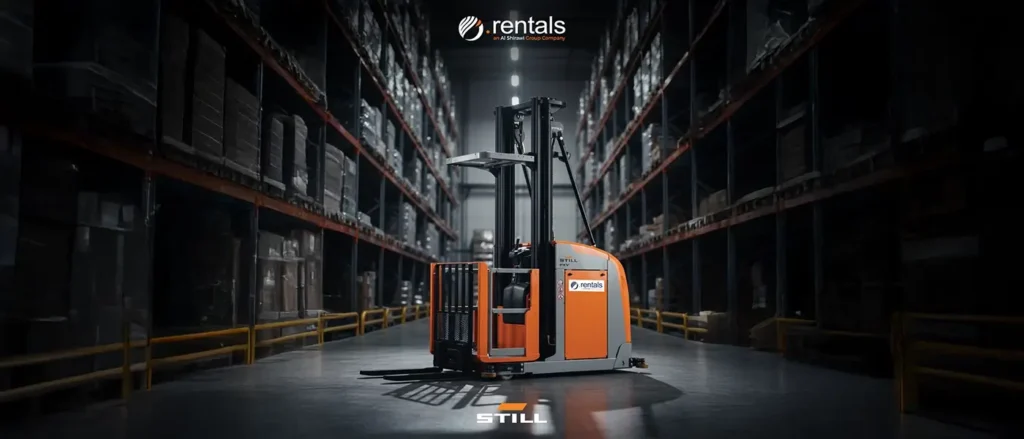
A reach truck is a warehouse forklift designed for narrow-aisle operation, built with an extending forward mast that allows the forks to “reach” into a racking bay while the truck’s wheelbase stays outside the load. This design lets reach trucks work in aisles as narrow as 2.5 to 3 metres, compared to the 3.5 to 4 metres a standard counterbalance forklift typically needs.
Reach trucks use outrigger legs rather than a full counterweight at the rear, which reduces their overall footprint. Most models lift to heights of 10 to 13 metres, making them the standard choice for high-bay pallet racking. Because the mast extends rather than the whole chassis moving forward, operators can place and retrieve pallets with tighter precision at height.
In practical terms, a reach truck is the equipment of choice whenever a warehouse needs to combine vertical storage with narrow aisles, something a standard forklift simply isn’t built to do efficiently.

Reach Truck vs Standard Forklift: Key Differences
The core difference comes down to how each machine handles space, height and load positioning. Here’s a direct comparison:
Feature | Reach Truck | Standard Forklift |
Aisle width required | 2.5–3.0 m | 3.5–4.0 m+ |
Maximum lift height | Up to 13 m | Typically up to 6–7 m |
Operating environment | Indoor, warehouse racking | Indoor and outdoor, yards, uneven ground |
Load capacity | Usually 1.4–2.5 tonnes | 1.5–5 tonnes+ |
Stability method | Outrigger legs | Rear counterweight |
Best suited for | High-density pallet racking | Loading docks, container work, mixed terrain |
Power source | Almost always electric | Electric, diesel or LPG |
The table shows why the two machines aren’t really competitors in the traditional sense. They’re built for different jobs. A standard forklift is more versatile across varied terrain and heavier, bulkier loads. A reach truck is a specialist tool for vertical, narrow-aisle warehouse storage.
When a Reach Truck Is the Better Choice
A reach truck is the better choice whenever warehouse space is limited and vertical storage is the priority. If your racking goes above 6 metres, or if you’re trying to fit more racking bays into a fixed floor area, a reach truck will outperform a standard forklift on nearly every metric that matters for productivity.
Specific scenarios where reach trucks make the clearest difference include:
- High-bay racking above 6 metres. Standard forklifts lose stability and lift capacity at height. Reach trucks are purpose-built for it.
- Narrow-aisle warehouse layouts. Converting to narrow-aisle racking with a reach truck fleet can increase usable storage space by 30–40% compared to wide-aisle layouts served by standard forklifts.
- High-throughput pallet handling. Because reach trucks manoeuvre within tighter aisles, operators spend less time turning and repositioning, which speeds up put-away and picking cycles.
- Cold storage and controlled environments. Electric reach trucks produce no emissions, making them the practical choice for chilled or frozen warehousing where forklift access is restricted.
- Facilities aiming to maximise cubic storage. If floor space is expensive or limited (a common issue in UAE logistics hubs like Dubai Investment Park or Jebel Ali), reach trucks let you build up instead of out.
A warehouse manager expanding storage capacity without expanding the building footprint will almost always land on a reach truck as the more productive, more space-efficient solution.

When a Standard Forklift Still Makes Sense
Reach trucks aren’t the right answer for every job, and a good equipment strategy recognises that. Standard forklifts remain the better option when:
- Loads need to move outdoors or across uneven surfaces, such as yards, loading bays or construction sites.
- Heavier loads exceed reach truck capacity, particularly above 2.5 tonnes.
- Operations require frequent transport between buildings rather than storage within a single racking system.
- Diesel or LPG power is preferred for outdoor or high-usage environments where charging downtime for electric equipment isn’t practical.
- Budget constraints favour a single, multi-purpose machine over specialised equipment for a smaller warehouse with wide aisles already in place.
In many operations, the most efficient setup actually combines both: a standard forklift for receiving, loading docks and yard work, paired with a reach truck for internal, high-density storage and retrieval.
Reach Truck Rental vs Buying: Which Makes More Sense
For most UAE businesses, reach truck rental makes more financial sense than an outright purchase, particularly when demand fluctuates seasonally or when a project has a defined timeline.
Renting removes the upfront capital cost, which for a new reach truck can run into six figures in AED. It also shifts maintenance, servicing and breakdown cover onto the rental provider, reducing the operational burden on your own team. For businesses testing narrow-aisle racking for the first time, reach truck hire is a low-risk way to confirm the equipment suits the layout before committing to a purchase.
Buying tends to make more sense when a reach truck will run at high utilisation year-round for several years and the business has the internal capacity to manage servicing and depreciation.
A quick way to decide:
- Estimate expected usage. Under 12 months or seasonal, rent. Multi-year, constant use, consider buying.
- Check your cash flow priorities. Renting preserves capital for other operational needs.
- Assess maintenance capability. If you don’t have an in-house technical team, renting includes servicing as part of the agreement.
- Factor in flexibility. Rental agreements let you upgrade or swap equipment as warehouse needs change.
O.rentals offers both short-term and long-term rental and lease agreements on reach trucks across the UAE, giving warehouses the flexibility to scale equipment up or down as operational needs shift, without the long-term commitment of ownership.

Best Practices for Getting the Most from a Reach Truck
- Match the mast height to your actual racking, not your maximum possible height. Oversized masts add unnecessary cost and reduce manoeuvrability.
- Train operators specifically on reach truck controls. The reach and tilt mechanisms differ meaningfully from counterbalance forklifts, and proper training reduces damage to racking and stock. O.rentals can support with operator training and best practices.
- Plan aisle widths before ordering racking. Confirm your reach truck’s minimum turning and reach dimensions against your racking layout before installation.
- Maintain battery charging schedules. Electric reach trucks need a planned charging routine to avoid downtime during peak shifts.
- Inspect outriggers and forks daily. Because reach trucks rely on outrigger stability rather than a counterweight, wear on these components has a bigger safety impact than on a standard forklift.
Common Mistakes Warehouses Make
- Choosing aisle width based on the forklift they already own, rather than designing the layout around the most space-efficient equipment available.
- Underestimating training time. Reach truck operation, particularly at height, requires more skill than standard forklift driving, and rushing operator onboarding increases accident risk.
- Renting the wrong lift height. Ordering a reach truck rated for less height than the top racking level, which limits usable storage.
- Ignoring floor condition. Reach trucks need a flat, well-maintained warehouse floor; uneven surfaces affect mast stability at height.
- Overlooking battery capacity for shift patterns. A single-shift battery in a two-shift warehouse leads to unplanned downtime.
Choosing a Reach Truck Rental Partner in the UAE
The right rental partner should offer more than just the equipment. Look for a provider with genuine warehousing experience, a maintained fleet, fast breakdown response and flexible contract terms that match your project timeline.
O.rentals is a UAE-based rental and leasing company with direct experience supplying reach trucks and other warehouse forklifts to logistics operators, distribution centres and manufacturing facilities across the region. The team understands the practical realities of UAE warehousing, from high-bay cold storage in Dubai Investment Park to fast-moving distribution hubs near Jebel Ali and can help match the right reach truck specification to your racking and throughput requirements.
Conclusion
Reach trucks and standard forklifts solve different problems. A reach truck earns its place whenever a warehouse needs narrow aisles, high-bay racking or better cubic storage efficiency, while a standard forklift remains the more practical choice for outdoor work, heavier loads and mixed-terrain handling. Many UAE warehouses get the best results by running both, matched to the right task.
If your warehouse is planning a layout change, adding high-bay racking, or simply needs extra lifting capacity for a busy period, reach truck rental gives you access to the right equipment without the capital cost or long-term commitment of buying. Getting this decision right has a direct, measurable effect on storage density, picking speed and overall warehouse productivity.
Get a Reach Truck Rental Quote
O.rentals supplies reach truck rental and reach truck hire across the UAE, backed by a well-maintained fleet and a team that understands warehouse forklifts and real operational demands. Whether you need a short-term rental for a seasonal peak or a longer lease as you scale your warehouse, we’ll help you find the right specification for your racking and throughput.
Contact O.rentals
Tel: +971 4 8855 169
Email: rentals@o.rentals
Services
Mobile: +971 50 107 6064
Toll Free: 800 RENT (7368)
Rental
Mobile: +971 50 640 9780
Toll Free: 800 LEASE (53272)
Address:
Dubai Investment Park 2, PO Box 282679, Dubai, UAE
Frequently Asked Questions (FAQs)
What is the difference between a reach truck and a forklift?
A reach truck is a type of forklift designed for narrow-aisle warehouses, using an extending mast and outrigger legs to lift pallets at height within tight spaces. A standard forklift uses a rear counterweight for stability and works better across wider aisles, yards and outdoor terrain.
How narrow can aisles be with a reach truck?
Most reach trucks can operate in aisles between 2.5 and 3 metres wide, compared to 3.5 metres or more for a standard counterbalance forklift.
Can a reach truck be used outdoors?
Reach trucks are designed for indoor warehouse use on flat, level flooring. They're not suited to yards, uneven ground or outdoor loading areas, where a standard forklift performs better.
Is it cheaper to rent or buy a reach truck in the UAE?
For seasonal, project-based or fluctuating demand, renting is typically more cost-effective since it avoids the upfront purchase cost and includes maintenance. Buying makes more sense for constant, multi-year, high-utilisation operations.
What lift height do reach trucks reach?
Most reach trucks lift between 10 and 13 metres, though this varies by model. It's important to match the mast height to your actual racking, not just the maximum available.
Do reach trucks require special operator training?
Yes. Reach truck operation involves different controls than a standard forklift, particularly around mast extension and lifting at height, so operators need specific reach truck training even if they're already forklift certified.
What load capacity do reach trucks handle?
Most reach trucks handle between 1.4 and 2.5 tonnes. Heavier loads generally require a standard forklift or a specialised high-capacity model.
How quickly can I get a reach truck on rent in the UAE?
Availability depends on fleet stock and specification, but reputable UAE rental providers like O.rentals typically arrange delivery within a short turnaround once requirements are confirmed. Contacting the rental team directly with your racking height, aisle width and load details speeds up the process.